‘Escape from the shadows’: a concert of Jewish-Polish music for viola and piano
Performers:
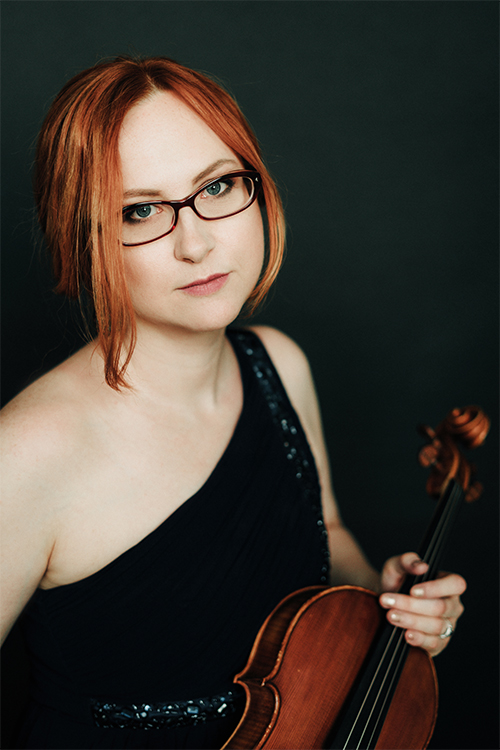
- Aleksandra Demowska-Madejska - viola
- Wojciech Pyrć - piano
Since 2019, thanks to musicological research in the field of Polish compositions of the nineteenth and first half of the twentieth century, we have been able to find and restore unknown and unfinished works for viola by Polish composers of Jewish origin.
Along with pianist Wojciech Pyrć, scholarship holder in the Ministry of Culture ‘Young Poland’ Programme, Aleksandra Demowska-Madejska arranged the nineteenth-century works in this programme.
The programme includes:
- Maria Szymanowska – Serenada (version for viola and piano) (1840)
- Maurycy Moszkowski – Three pieces op. 29 (1882)
- Ignacy Friedman – Romance for viola and piano (1938)
- Jerzy Fiteleberg – Serenade for viola and piano (1945)
- Mieczysław Wajnberg – Sonata for viola and piano (1945)
- Karol Rathaus – Notturna Rhapsody op. 66 for viola and piano (1950)
Plus works of Alexander Veprik associated with Warsaw of the early twentieth century.
The project aims not only to enrich the Polish viola repertoire with ambitious works, but also to show how important the contribution of Jewish artists of Polish origin was to the development of our country’s culture.
Mieczysław Wajnberg is still quite widely considered to be a ‘Soviet’ artist, although he was born and lived in Warsaw for 20 years, until he had to flee from the invasion by Nazi Germany in September 1939. He never planned to emigrate voluntarily, and in his early works one can hear the Polish idiom and references to the Polish national tradition. He settled in Moscow because of his friendship with Shostakovich. Under Shostakovich's influence, in 1945 he created the Sonata op. 28, intended for viola or clarinet with piano accompaniment. Most recordings of this work use the clarinet, while the version for viola remains constantly overshadowed in both concert performance and recording. The viola version was arranged in 2008 by the great German violist Julia Rebekka Adler.
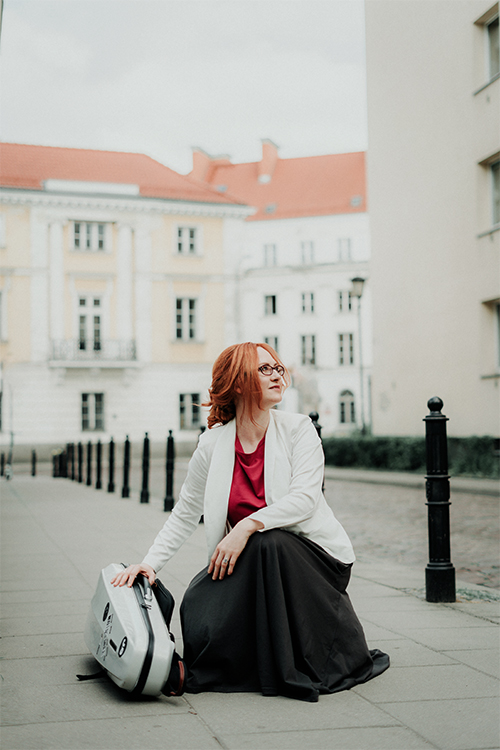
Jerzy Fitelberg was also born in Warsaw, the son of famous conductor Grzegorz Fitelberg. The war forced him to leave Europe for good. Composing in the USA, he remained faithful to late Romantic ideals, filled with Polish folklore and Tatra melody. Composed in 1943, the Serenade for viola and piano is an extremely melodic work, recorded only by American performers, and in Europe not only never recorded but also never performed.
Karol Rathaus, born in Ternopil, also died in the USA. His compositions were influenced by the Second Viennese School. He was an active Polish community activist in the USA (including being a member of the Music Committee of the Institute of Culture). In 1950 he composed the ‘Rhapsody notturna’ op. 66 for viola or cello with piano accompaniment. This piece has only been recorded in the cello version, in an archive recording from the 1950s.
Works, composers and an instrument (viola) restored from the shadows give a coherent image of the concept of the concert.
Non-obvious Matters
The solo musical project of Aleksandra Demowska-Madejska combines existing 21st-century compositions with numerous dedications inspired by a broad interpretation of solid matter. Non-obvious Matters – touched through the sense of hearing, interpreted through love for them, the need to feel their texture, and the specific, almost cosmic emptiness that arises in their absence. Matter as the essence of every shape, the nanoparticle of everything animate and inanimate, an attempt to answer the question whether only that which we can touch truly “exists.” How can immaterial sounds convey the shapes and nature of “things,” and is this even possible?
For me, Non-obvious Matters is a project in which music seeks to unite with sensory experience and, through sonoristic experiments, to transcend the barriers between touch, sight, and hearing.
Artists from Canada, Colombia, Brazil, the United Kingdom, Germany, and Poland are involved in Aleksandra’s project.
As part of many years of work on these pieces, the concept album FURL (released by PGM, Canada) was created.
Wioleta Żochowska on the album:

The latest chapter in music history has opened up many exciting possibilities for the viola. In the hands of a new generation of performers and composers, it has undergone a series of transformations, becoming the subject of bold experiments. This revolution in thinking about the instrument has allowed us to hear it anew: without prejudices rooted in the tradition of the string quartet or orchestra, and above all, without comparisons to the violin. Although viola’s body is only three centimetres longer than that of the violin, it requires a wider spacing of the fingers. The larger body offers a whole range of unprecedented sonic qualities. Its deep timbre, often compared to the human voice, provokes the search for new methods of articulation, preparation, and combination with electronic instruments and media. This, in turn, opens the way to a new musical virtuosity still lacking in the available viola literature.
For years, the foremost Polish violist ALEKSANDRA DEMOWSKA-MADEJSKA has been searching for new methods of expressing herself through the viola, establishing numerous collaborations with artists, promoting the instrument both in projects related to new music as a member of the Hashtag Ensemble and in 20th-century repertoire, both in duets and solo. She first picked up the viola in the seventh grade of music school, when, due to worsening migraines and a growing sensitivity to high notes, she considered abandoning the violin altogether. Interested in the human body, chemistry, and biology, she considered medical studies instead. However, before deciding to end her musical career, she gave the viola a chance. The instrument not only won her heart—she immediately fell in love with its soft and subtle sound—but also perfectly complemented her personality. Yet, her interest in the human body and sensual exploration of the world has continued and remains an important aspect of her life, which is reflected in the music presented on this album.
The idea for her first solo album of contemporary music matured over the years. All it took was a single impulse – a meeting with two composers at a composition course in Radziejowice, where Aleksandra Demowska-Madejska was a resident in 2019 – for the idea to begin to take fuller shape, as the violist’s concept centred on musical ways of conveying changing shapes (pun intended). During a conversation with British composer Sarah Westwood, a graduate of Goldsmiths, University of London, who in addition to concert music creates works for dance, musical theatre, and sound installations, the artists began to consider how to convey the energy of a curling leaf using contemporary viola techniques. The idea wasn’t to create sound painting or imitate the sounds of nature, as the rustling of leaves could be easily notated, imitated, and then recognised by the listener. Instead, the artists sought new timbral qualities. Thus, the piece Furl for amplified viola was born, whose title also became the name of the entire album.
In her artistic endeavours, SARAH WESTWOOD explores oppositions such as memory and fading, embodiment and transcendence, and also focuses on the somatic. The body and its themes are particularly close to her heart. Furl is built on opposites – the delicate, ASMR-like [Autonomous Sensory Meridian Response] friction of a leaping bow contrasts with the hauntingly harsh wailing of the strings. The viola’s sound oscillates between dynamic extremes, and before the sound fully develops, it begins to fade. The irregular pulse evokes a subconscious anxiety, signalling change – the only constant in life.
Aleksandra Demowska-Madejska, knowing the composer’s interests, commissioned her to write another piece. Lasting more than sixteen minutes, Each Branch of a Coral Will Hold Up the Moon for amplified viola contrasts with the tense Furl and is also the longest piece on the album. Despite its sparse means of expression and minimalist soundscape, the work presents the violist with exceptional challenges. Westwood, inspired by Buddhist thought, subtly stretches phrases, interpreting the passage of time in a way in which some changes are so subtle that they occur at the edge of perception.
The sensual experience of the world evokes diverse emotional responses. In her work, German composer JEANNE ARTEMIS strives to create a sonic space with soothing properties. In Message II for solo viola, the aural universe is composed of sonic particles, that respond with light to darkness and suffering. The musical fabric, shimmering with microtones and enriched with palpitating tremolos and trills, leaves room for breath, though with each subsequent inhalation it thickens, changes, and ultimately fades away.
Small, immobile, and seemingly soundless objects, such as stones, inspired the violist to explore that sonic world with composers. The question of how to convey its essence and transformations through sound became the starting point for further experimentations. Close collaboration with artists, both in concert and recording projects, became her hallmark. Music created in dialogue, in search of new boundaries for the viola’s sound, resulted in another piece, The Inconvenience of Loving a Flickering Creature for amplified viola by MICHELE ABONDANO. The Colombian composer whom Aleksandra met in Radziejowice, bases her work on the exploration of tone colour, examining its multidimensionality and dynamics. Her work was inspired by the fantasy of animating inanimate matter. As in cartoons, where objects and phenomena acquire human characteristics, in this composition, solid matter is anthropomorphised. However, it resembles neither a human nor an animal but becomes something entirely new. To create new sounds for the viola, Abondano proposed a series of preparations. To meet the requirements of the score, Aleksandra Demowska-Madejska searched long for the right elements that would achieve the intended sonic effects. Playing such a modified instrument required the development of new techniques, especially since the composer introduced quarter-tones, multiphonics, and unconventional bowing techniques. Under Aleksandra Demowska-Madejska’s fingers all of this makes the viola shimmer with colour, its sound transcending the familiar timbral horizon. A journey through the susurrous and whirring palette leaves open the question of the instrument’s sonic identity.
TATIANA CATANZARO pursued a similar line of exploration and approach to the viola sound, this time using electronics instead of preparation. Her piece Intarsia for viola and live electronics, which Aleksandra Demowska-Madejska discovered during her research, opens the entire album. The Brazilian composer and musicologist performs a kind of vivisection of the instrument, electronically processing its sound in real time. The titular inlay is a decorative technique that involves creating patterns on the surface of wooden objects. In a musical context, it becomes a way to modify the viola’s sonic capabilities. Thanks to it, the instrument’s tone acquires metallic characteristics, in which it slowly immerses and submerges. A penetrating tremolo, blurring the line between acoustic and electronic sound, builds an internal tension that forms the framework of the entire composition.
A different approach to electronic sound processing is presented on this album by Polish composer and violinist KATARZYNA TABOROWSKA. The artist focuses on expanding the sonic possibilities of instruments and exploring new timbral combinations. The composer and Aleksandra met at the Poznań Music Spring festival (the second oldest New Music festival in Poland, the first being the renowned Warsaw Autumn), where Taborowska accepted an invitation to create a new piece for viola and live electronics. The collaboration resulted in the dreamlike Filings on a Silken Thread. The piece evokes associations with the achievements of the Polish Radio Experimental Studio school, taking on various forms, shifting like a chameleon and exhibiting diverse timbral configurations. The composition incorporates elements of improvisation and a range of extended performance techniques, including the percussive treatment of the soundboard, which houses microphones. The initial pulse, tapped out by the metronome, resembles a heartbeat, and the viola follows its tempo. Over time, the electroacoustic sound refracts, transforms, and splits, revealing a rainbow of colours as if through a prism.
PIOTR GRELLA-MOŻEJKO addresses the initial question of the movement of solid matter in his piece ...okiem spokojnym bardzo jasnym [with a calm and very clear eye] for viola, tape, and live electronics, written especially for Aleksandra Demowska-Madejska. In this composition, the artist manipulates the sound through microtonal retuning of the strings, giving the instrument a new identity, which he juxtaposes with rhythmically pulsating electronics. Against this backdrop, another layer unexpectedly emerges—the recording of the performer’s voice interpreting Zbigniew Herbert’s poem “Kamyk” [Pebble]. For the violist, performing the text was a considerable challenge, a gesture that brought her even closer to the instrument and added another chapter to the story of the potential inherent in seemingly motionless and disembodied matter.
Wioleta Żochowska
translated by Piotr Grella-Możejko- Tatiana Catanzaro – Intarsia for viola and live electronics [4’42”]
- Jeanne Artemis – Message II for amplified viola [5’48”]
- Sarah Westwood – Furl for amplified viola [4’07”] *
- Katarzyna Taborowska – Opiłki na jedwabnej nici for amplified viola and live electronics [12’33”] *
- Michele Abondano - The Inconvenience of loving a flickering creature for amplified viola [9’15”] *
- Sarah Westwood - Each branch of a coral holds up the moon for amplified viola
[16’33”] * - Piotr Grella-Możejko - Piotr Grella-Możejko …okiem spokojnym bardzo jasnym for amplified viola, tape and live electronics [7’28”] *
*Phonographic premiere
@ModernViola
Aleksandra Demowska-Madejska has specialised in performing new music for several years. She devoted five years to expanding performance techniques, which led to her doctoral degree. The subject of her thesis was pieces for solo viola written by Polish composers born after 1970. As a result of her academic and performing work, several Polish and other composers have dedicated solo viola pieces to her:
- Sarah Westwood – Furl
- Dariusz Przybylski – Drei Formen
- Aled Smith – Ex
- Sławomir Zamuszko – Suite
- Aleksander Kościów – Phantasie
- Rafał Zalech – Stadium I
- Andrzej Kopeć – Emotion-Emission-Evaporation
- Hugo Vasco-Reis – Metamorphosis and Resonances
- Krzysztof Penderecki – Cadenza
- Michał Moc – Quipo i Quincunx
- Paweł Mykietyn – Air
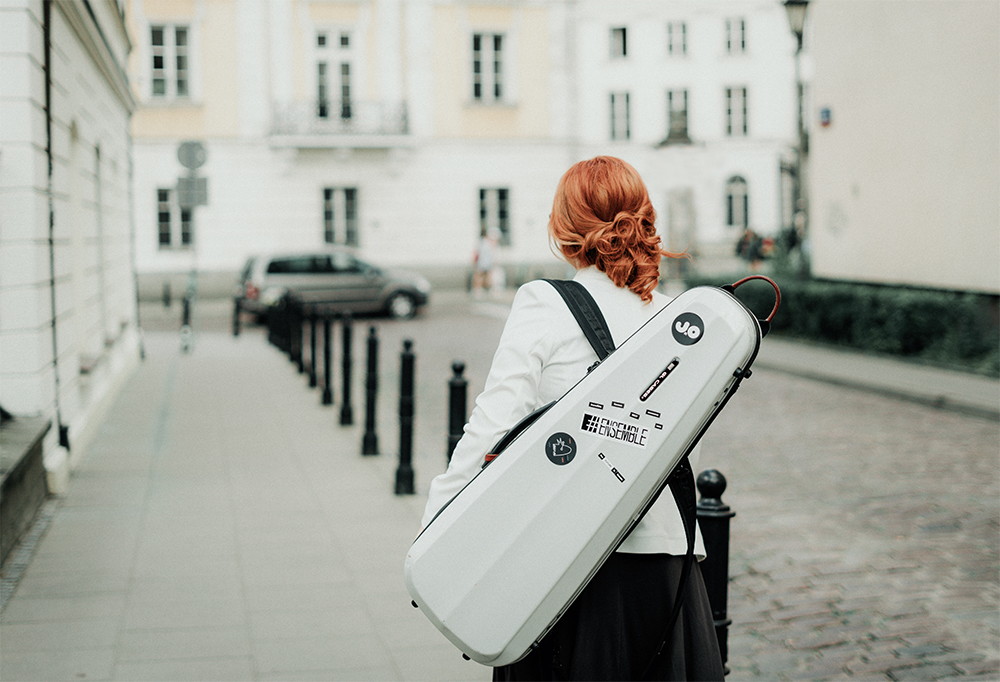
Double concertos for viola, clarinet and string orchestra – dedications
Performers:
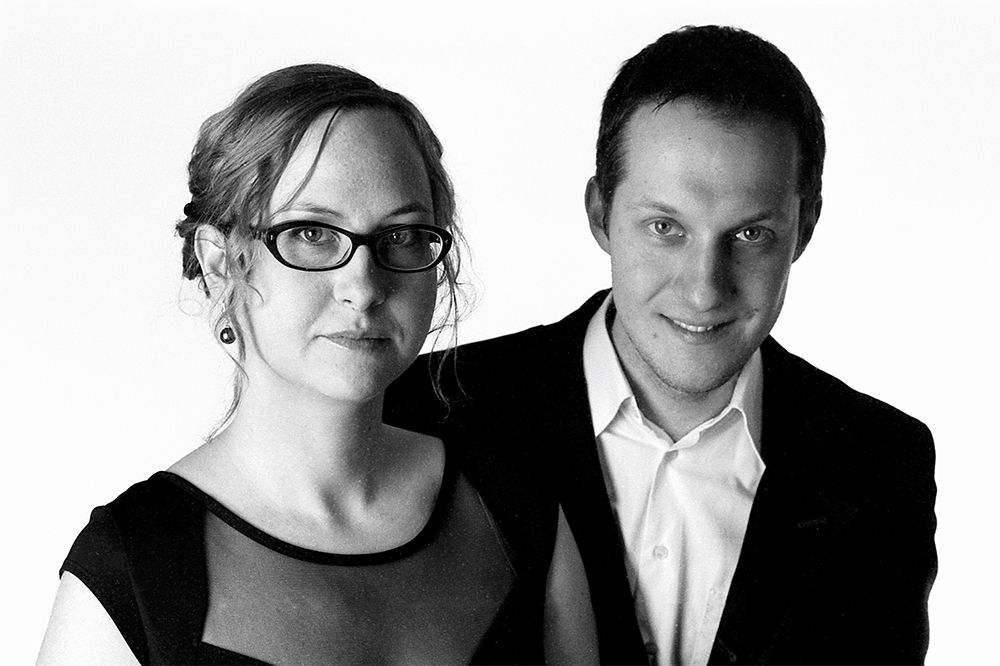
- Aleksandra Demowska-Madejska - viola
- Adam Eljasiński - clarinet
Since 2015, the Demowska / Eljasinski duo has been establishing contact with numerous contemporary composers in order to expand the repertoire for this duo of soloists with the accompaniment of a string orchestra. Having in their repertoire the Bruch double concerto, the duo decided to reinterpret the concert dialogue and look for other forms of expression in commissioned works of the 21st century. To date, the duo has performed concerti written for them by Polish composers including Wojciech Błażejczyk, Dawid Pajdzik and Weronika Ratusińska-Zamuszko. The Chilean composer Julio Torres also dedicated his concerto to the duo.
The duo have performed with orchestras including the Gorzów Philharmonic, the Radom Chamber Orchestra and the InterCamerata Orchestra. They have also performed outside Poland, and in 2018 they released a live album from their concert opening the Clarimania festival in Wrocław. The duo have performed at festivals including the 4th Svatováclavský Hudební Festival, Prague Clarinet Days (2017) and Clarimania 2018. Both performers are members of the new music group Hashtag Ensemble and members of the Association of Polish Musicians.
Pieces written for the duo are characterized by unusual stylistic diversity, from tonal and neoclassical works, through neo-romantic postmodernism, to experimental music.
Since 2015, the duo have also been expanding their activities by forming Trio Olympus Mons with pianist Anna Hajduk-Rynkowicz, performing late-Romantic repertoire and new music written for them.
Aleksander Tansman viola concerto in an original arrangement for string quintet with solo viola
Thanks to the scholarship of the Polish Minister of Culture and National Heritage in 2019, the arrangement of the Alexander Tansman Concerto for solo viola with string quintet was created.
The aim of the project was to restore this forgotten work, the first Polish viola concerto with orchestra accompaniment, to perform it life in Poland and abroad, by developing the piece so that it can be performed in smaller ensemble (with accompaniment to string quintet).
Thanks to the Aleksandra Demowska-Madejska scholarship, she prepared author's arrangement of the score and voices and developed the solo voice of the viola (stringing and fingering, revision of articulation annotations, interpretation issues).
The artist is one of the few performers on a global scale to have a Tansman concerto in their concert repertoire.
*Completed as part of a scholarship from the Minister of Culture and National Heritage

Hashtag Ensemble is a music cooperative specializing in contemporary music, improvisation and musical education, established and lead by flutist Ania Karpowicz
Members of the cooperative are young Polish musicians: composers, vocalists, instrumentalists and a conductor from leading cultural institutions such as Sinfonia Varsovia Orchestra, Polish Radio Orchestra, Polish Royal Opera or The Fryderyk Chopin University of Music.
Hashtag Ensemble cooperates with composers and has ordered new pieces from Jagoda Szmytka, Artur Zagajewski, Agnieszka Stulgińskia, Adam Porębski, Paweł Malinowski and Zygmut Krauze, among others. It has in its repertoire classical works of 20th century music, by Peter Maxwell Davies, Louis Andriessen, Helmut Lachenmann, Georg Crumb, Gerard Grisey, Steve Reich and others.
Although each of the mentioned pieces is freely available on the Internet, a virtual listening experience is evidently inferior to a live concert by Hashtag Ensemble. There was truly a mastery to their performance. Given that they’re a considerably young ensemble, one should hope that they won’t rest on their laurels and that composers will thus have someone to write for.

Filip Lech
culture.pl, POLIN Music Festival 2018
What can surely be written without worrying about any spoilers is that Hashtag Ensemble has, once again, proven itself to be not only a collective of remarkable performers, but also a band with a certain concept of itself; a band who wants to experiment far beyond conventional concerts.

Krzysztof Stefański
Glissando, KODY 2019
Contemporary music is a sort of a utopia, a kind of longing for “more” – it demonstrates a certain set of values. That notion is shown in Louis Andriessen’s “Workers Union” (performed ravishingly, almost perfectly by the band – and without a conductor!).

Adam Suprynowicz
Ruch Muzyczny, Sacrum Profanum 2019Hashtag Ensemble operates by creating egalitarian structures based on multi-layered activities of its members and by buliding programmes based on legible and usually non-musical contexts. An important element of the group’s concert practice is support and presentation of artistic achievements of women – since it’s beginning the group has cooperated with multiple female composers and artists. Only in 2018 the ensemble performed the works of Jagoda Szmytka, Agata Zubel, Agnieszka Stulgińska, Age Veroos and Rebecca Saunders.
The group has performed at numerous festivals, such as POLIN Music Festival, Warsaw Autumn, Sacrum Profanum (Cracow), Tallin Afekt Festival, Poznańska Wiosna Muzyczna (Poznan Music Spring), Musica Electronica Nova (Wroclaw), Musical Gardens Festival (Warsaw), Warsaw Music Encounters. The cooperative has been hosted by prominent concert halls, such as Solti Hall in Budapest, National Philharmony in Minsk, Sala Laboratorium at the Centre for Contemporary Art in Warsaw, but also music clubs such as Meskalina in Poznan or Boogaloo and Skwer in Warsaw. Hashtag Ensemble performs finalists’ compositions at composers’ competitions, e.g. at the Baird Composers’ Competition and 15th International Serocki Competition.
One of important areas of the group’s activity is improvisation, which has produced three improvisational threads so far. „Visegrad Songs” (CD 2016) is a reinterpretation of motives taken from 19th century classical music, “#WITKACY” (CD 2018) presents a musical re-reading of photographic autportraits by Stanisław Ignacy Witkiewicz, performed during the SOUNDLAB project in the M. Karłowicz Philharmony in Szczecin (among other performances), and the newest thread „urb<s>core”, consists of closed improvisational forms inspired by photographic scores by Zbyszek Siemaszko, revolving aroung the theme of Warsaw’s modernist architecture.
Hashtag Ensemble has produced two repertoir albums: #NetworkMusic (2018), which traces the group’s artistic explorations and development in years 2013-2017, and „Trash Music” (2018), which presents a study on the works of Wojciech Błażejczyk. All Hashtag Ensemble albums have been have been published with Requiem Records Opus Series.
Hashtag Ensemble is engaged in musical education as well. Since 2016 it has been performing educational concerts of contemporary music at the Ujazdowski Castle Centre for Contemporary Art in Warsaw, within the Smykowizje project. Only in 2017 the group has played 34 concerts for more than 1000 families, presenting the works of Crumb, Andriessen, Schoenberg, Penderecki and many young Polish composers.
Hashtag Ensemble cooperates with other new music groups in Poland and abroad (Spółdzielnia Muzyczna, Meitar Ensemble) and supports partnership builiding within the contemporary music environments – both musical and institutional.
- Ania Karpowicz – flutes
- Adam Eljasiński – clarinets
- Oliwier Andruszczenko – EWI, duduk
- Wojciech Psiuk – saxophones
- Hubert Zemler – percussion
- Paweł Janas – accordion
- Wojciech Błażejczyk – electric guitars, live electronics
- Piotr Sałajczyk – piano
- Krzysztof Kozłowski – synthesizers, samples
- Dariusz Przybylski – Hammond organ
- Marta Grzywacz – voice
- Maciej Nerkowski – baritone
- Kamil Staniczek / Kamila Wąsik-Janiak – violin
- Agnieszka Guz / Marta Piórkowska – violin
- Aleksandra Demowska-Madejska – viola
- Dominik Płociński – cello
- Mateusz Loska – double bass
- Lilianna Krych – conductor